Brochexpress — Beaurepaire & Lussery-Villars

CNC rotary table
& motorised
divider

Add a 4th or 5th axis to your existing machining centre, whatever its brand. Design, manufacturing and tailored integration since 1992.

< 1 µm Runout
5,000 rpm Max C-axis speed
±10" Angular precision
400 daN Max clamping force
// Animated presentation

The BHF 5-EMSR-PNE in 8 sequences

From the problem to turnkey integration: see how the chuck spindle turns your 3-axis machine into 4 axes.

Brochexpress
Brochexpress — The Art of Precision

What if your 3-axis machining center became 4 Axes

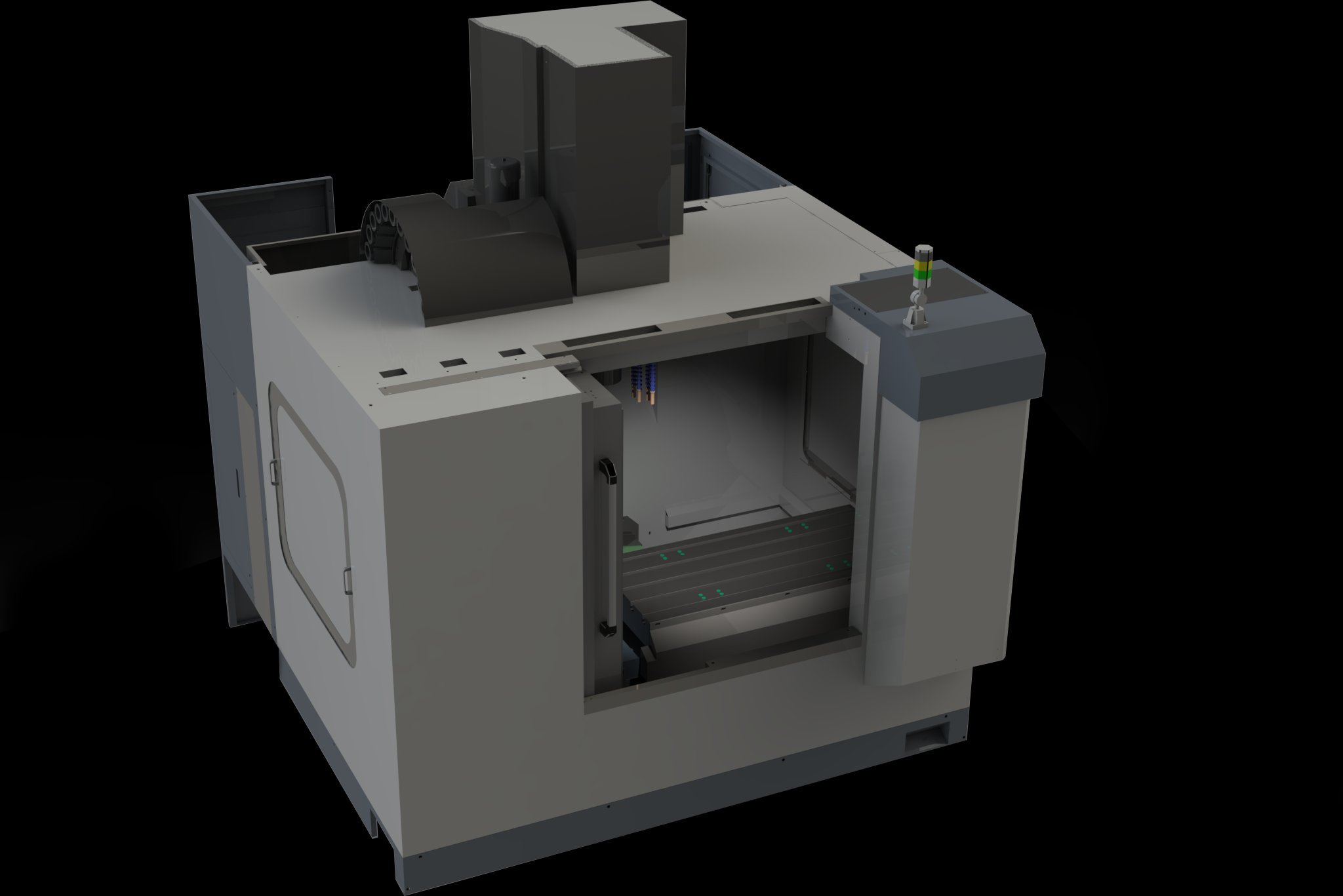
The BHF 5-EMSR-PNE motorized chuck spindle fits any vertical machining center and adds a full rotary axis — without modifying the CNC control.

3-axis machining center with BHF 5-EMSR-PNE chuck spindle
The context

Machine a part
on 4 faces
in a single setup

  • On a standard 3-axis machine, every repositioning introduces cumulative error
  • Manual re-clamping slows the cycle and ties up the operator
  • A dedicated 5-axis machine is an investment of several hundred thousand euros
  • There is an alternative: a rotary chuck spindle mounted on the table
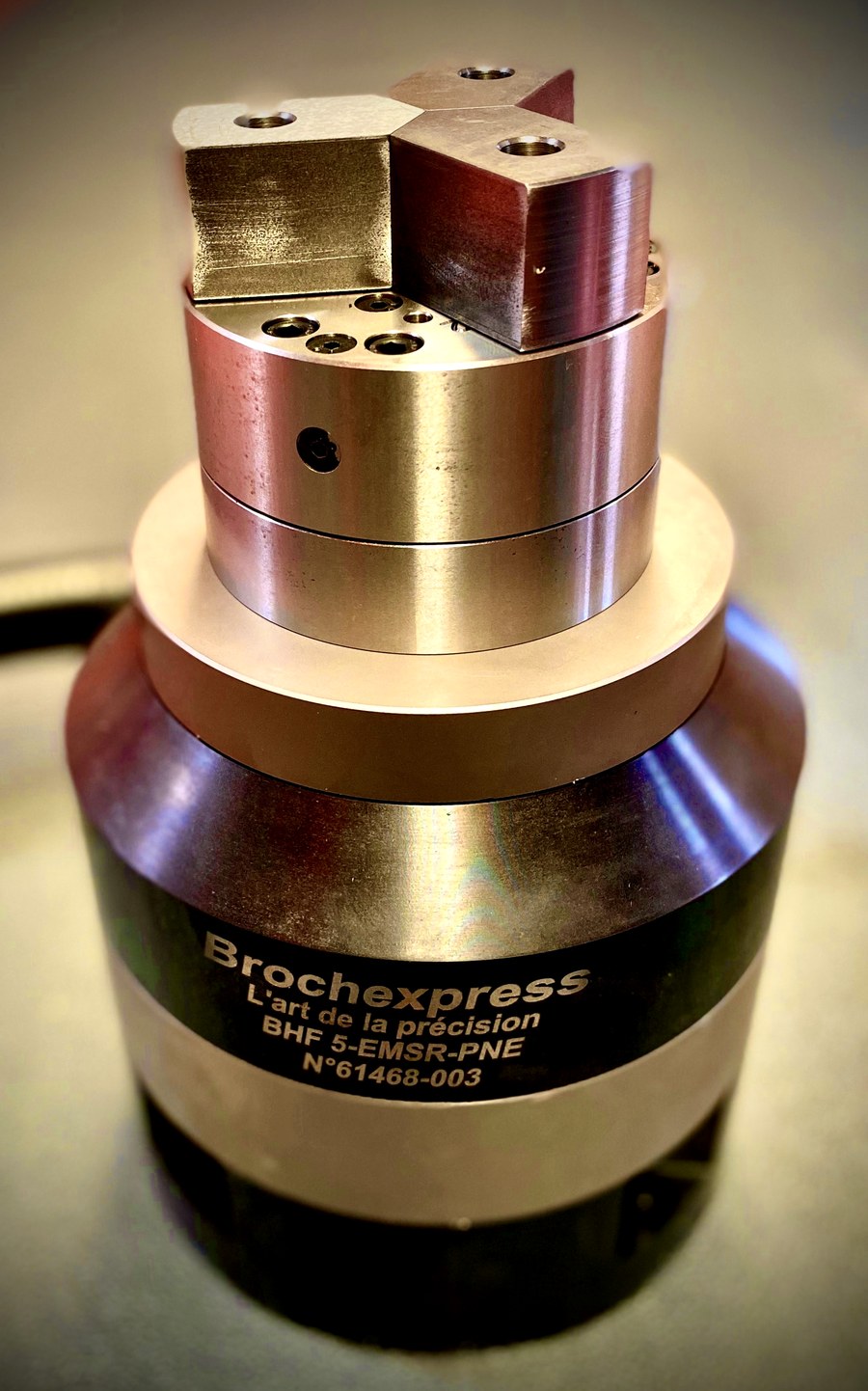
BHF 5-EMSR-PNE chuck spindle
The solution

BHF 5-EMSR-PNE

A motorized chuck spindle that mounts on the milling table through the existing T-slots. No drilling, no machine modification.

  • Pneumatic clamping at 6 bar — up to 400 daN of force
  • Integrated synchronous motor — 5,000 rpm
  • Runout < 2 µm
  • Lenord+Bauer sin/cos encoder for precise positioning
System architecture

3 components,
1 integrated system

CHUCK SPINDLE BHF 5-EMSR-PNE HFX hose 2.9 m CABINET 300×400 mm Dry contact MACHINE CNC Parallel control Filtered air 6 bar
Clamping system

Adjustable
pneumatic
clamping

Air pressure directly sets the clamping force. Adjustable per part, no tools.

PRESSURE → CLAMPING FORCE 1 bar 66 daN 2 bar 132 daN 3 bar 200 daN 4 bar 262 daN 5 bar 330 daN 6 bar 395 daN MAX
Mechanical performance

Metrology-grade
precision

< 2 µm Runout
5,000 rpm Maximum speed
11 N·m Maximum torque
256 teeth Encoder wheel m0.3
L182 Lifetime grease
Sealed Abrasive environment
Commissioning

Integration
in 3 steps

01
Mount on the table 4 × M6 screws in the T-slots — standard 100 mm spacing. No drilling.
02
Connect hose & air HFX hose 2.9 m to the cabinet. Filtered + regulated + lubricated air supply.
03
Dry contact on the CNC A single on/off signal from the CNC is enough. No software changes.
Brochexpress divider
Brochexpress — Beaurepaire (38) & Lussery-Villars (CH)

Your 3-axis machine,
transformed tomorrow

CNC BHF5
BHF 5-EMSR-PNE
Installation
Fixed with 4 × M6 screws in the existing T-slots.
No machine modification required.
0:15

What is a CNC rotary table?

One or two rotary axes driven by the CNC, to machine several faces of a part in a single clamping.

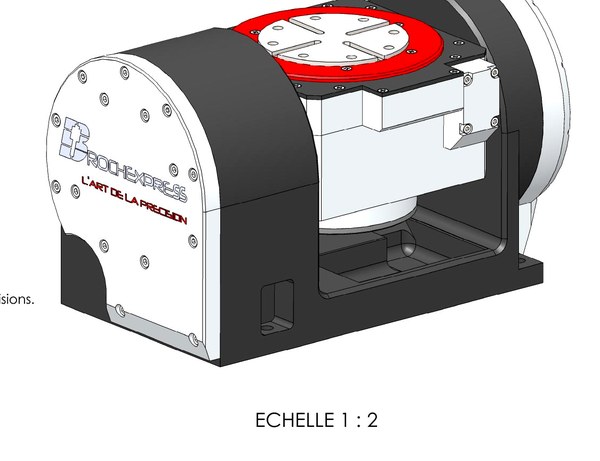
A CNC rotary table — also called a motorised divider, 4th-axis divider or 5th-axis rotary table depending on the configuration — mounts on the table of a milling machine or machining centre and adds one or two rotary axes driven by the CNC.

The point is to machine several faces, several angles or a complex geometry in a single clamping, instead of removing and repositioning the part at every change of orientation. Each manual re-clamp costs cycle time and introduces positioning error; removing it gains accuracy and repeatability.

In a 4-axis configuration, a single rotary axis is motorised — labelled A or B depending on its orientation, C when vertical. In a 5-axis configuration, two motorised axes, typically B and C, orient the part almost freely relative to the tool.

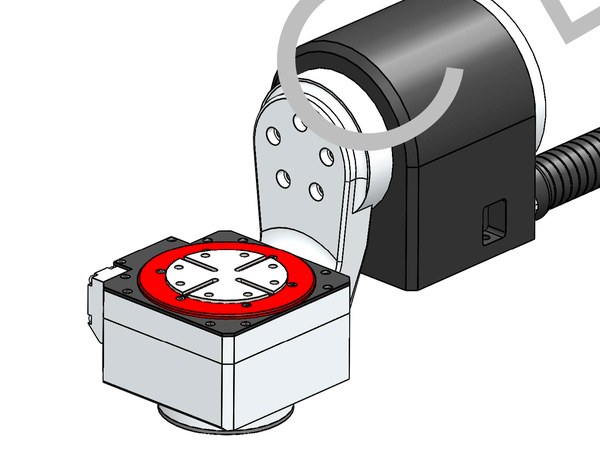
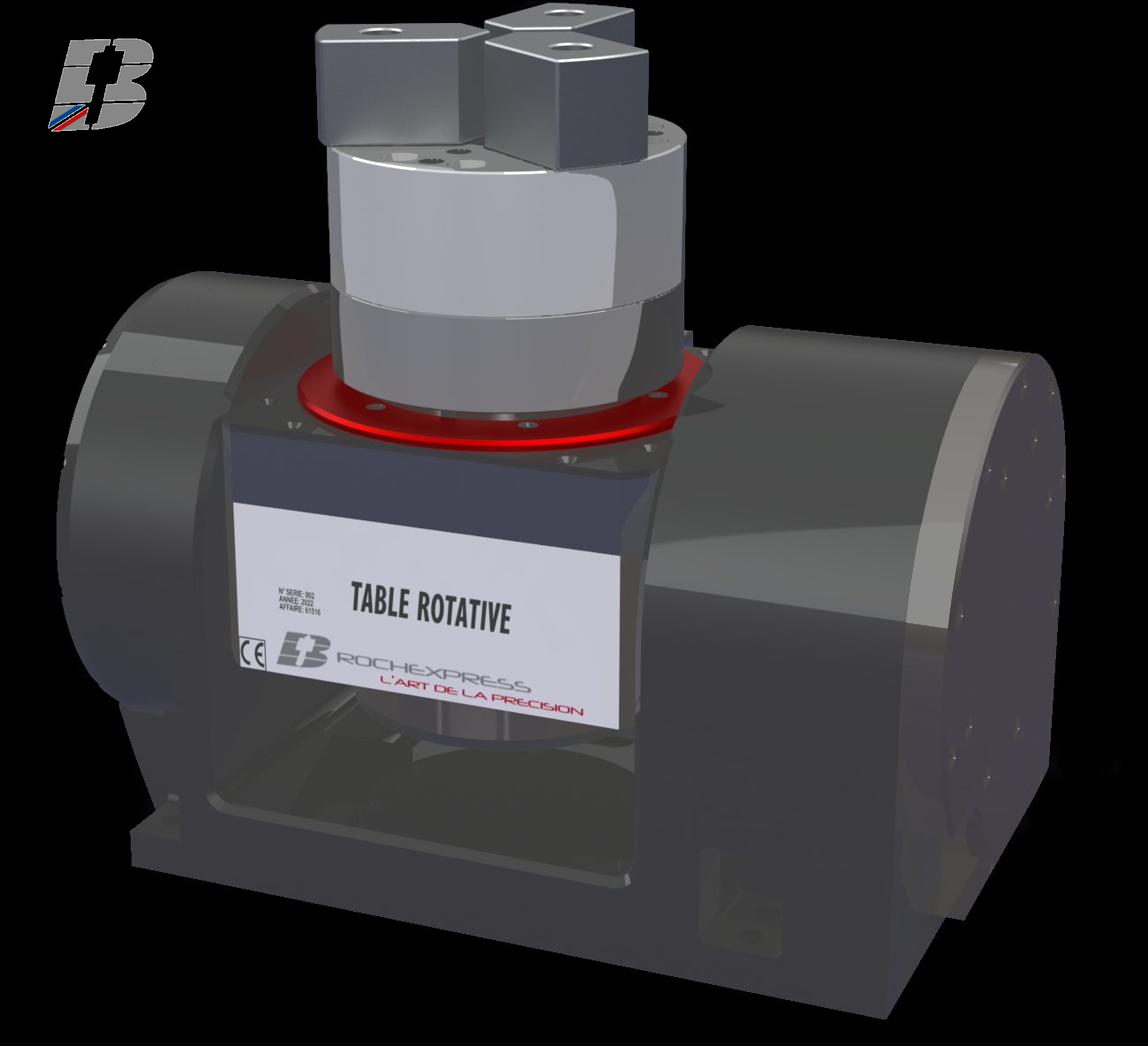
Our two references cover both cases: the DIV-5AX-MAN, a direct-drive rotary table with B and C axes, and the BHF 5-EMSR-PNE, a motorised chuck with pneumatic clamping that adds a C axis to a 3-axis machine.

The divider designed by spindle specialists

A motorised divider is first and foremost a high-precision rotation system — exactly what we have been doing since 1992.

A CNC rotary table shares the same fundamentals as a motor spindle: a high-precision shaft in rotation, carried by suitable bearings, driven by a motor whose torque and speed must be controlled, with thermal management that decides stability over time.

Most rotary table makers are specialists in tooling or in positioning generally, for whom the spindle is one catalogue line among others. With us it is the other way round: we have designed and repaired spindles and motor spindles for decades, and our dividers were born from applying that know-how directly to another rotating component.

That origin shows in the technical choices. Direct drive by three-phase synchronous motor, with no worm gear reducer, removes the backlash inherent to reduction systems. The angular accuracy of ±10 arcseconds on the B and C axes of the DIV-5AX-MAN comes from our command of optical encoders, the same ones used on our precision motor spindles. Cooling is by natural dissipation, with no active circuit to service, and lubrication is for life.

To go further on the components that decide the longevity of any rotating assembly: bearings and dynamic balancing.

High-precision chuck spindles

For high-speed precision divider applications on machining centers and milling machines.

Chuck spindle BHF 5-EMSR-PNE motorized chuck spindle — Brochexpress
Pneumatic chuck spindle

BHF 5-EMSR-PNE

Motorised 4th-axis chuck — 3-jaw pneumatic clamping

Max speed5,000 rpm
Runout< 2 µm
Torque S1 at vmax3.91 N·m
Max torque11 N·m
Power S10.2 kW
Max clamping force400 daN @ 6 bar
Outer diameterØ 155 mm
Weight19.76 kg
EncoderLenord+Bauer sin/cos
Gear wheel256 teeth, m0.3
MotorSynchronous 3-phase
Pneumatic supply6 bar max
  • Precision angular contact bearings, lifetime lubrication (L182 grease)
  • Mechanical parts in treated and ground steel, burnished and nickel-plated exteriors
  • Sealed version for abrasive environments — adjustable mechanical stop
  • Pick-up plate for rotation axis correction
  • HFX polyurethane metaloplastic conduit, 2.9 m (STAUBLI Combitac connector)
  • Mounts on milling table: 100 mm pitch, 4× M6 screws
View dedicated product page →

Precision dividers

Direct drive, torque motors, high-resolution TONIC optical encoders ±10".

5-axis divider DIV-5AX-MAN motorized 4th and 5th axis divider — Brochexpress
Motorized 4th & 5th axis divider

DIV-5AX-MAN

Direct drive, 2 independent axes (B & C) — TONIC optical encoder

Max C-axis speed5,000 rpm
Max B-axis speed143 rpm
Torque S1 (C & B)5 N·m
Max torque11 N·m
B-axis range+98° / −95°
B angular accel.150 rad/s²
Runout< 1 µm
Angular precision±10 arc"
EncoderTONIC optical
MotorSynchronous 3-phase
Dimensions (L×H)140 × 80 mm
Weight11.87 kg
  • Precision angular contact bearings on both axes, lifetime lubrication
  • Direct drive on B-axis: no mechanical play, maximum rigidity
  • Treated and ground steel parts, burnished and nickel-plated exteriors
  • Machine table interface, integrated power and encoder connections
  • Natural-dissipation cooling — no fluid supply required
View dedicated product page →
Custom study DIV-5AX-MAN SARIX divider — compact 5-axis variant — Brochexpress
5-axis divider — SARIX integration

DIV-5AX-MAN SARIX

Compact variant built to customer specifications — configurable B & C axes

Dimensions (L×H)149 × 63 mm
C-axis height55.5 → 85.5 mm
Mounting interfaceJs10 / Js10
Weight13.79 kg
B-axis speedPer spec
C-axis speedPer spec
Mechanical lockYes (configurable)
EncoderAbsolute or incremental
Workpiece clampManual or auto
Angular precisionPer spec
  • Developed in response to a specific customer specification (SARIX integration)
  • Compact footprint optimized for small 5-axis machining centers
  • All kinematic characteristics are defined with the customer upfront
  • Same build quality as the standard range: angular contact bearings, ground steel
  • Complete documentation provided: layout drawing, datasheet, electrical schematic

Turnkey commissioning

Parallel control to the CNC — no software changes required.

  • Dedicated control cabinet (300 × 400 mm) with Run / Stop / Servo console
  • Parallel control to the CNC — no software changes required
  • Dry contact provided for spindle Run / Stop command
  • Filtered, regulated and lubricated air supply (provided by installer)
  • Power cable 4G2.5² — Ethernet cable (ref. 47880)
  • Motor / encoder / pneumatic SP32 BL 10M conduit (ref. 563-927) — 10 meters

What sets us apart from the major catalogue ranges (Nikken, Haas, Isel)

The market is dominated by large catalogue ranges. Our ground is elsewhere: integration on an existing machine, and adaptation to the brief.

The major makers offer dozens of standardised references covering a wide span of sizes and applications. That approach has its merits — availability, abundant documentation, standardisation. It also has its limits: some ranges only reach their full accuracy and speed potential on machines and controls from the same maker. On another brand's machine, performance can be degraded.

Our dividers are conceived differently: built to fit existing machines regardless of brand, and open to adaptation according to the project's real specification rather than imposing a fixed reference. It is the same philosophy we have always applied to manufacturing our motor spindles.

A figure to anchor angular accuracy

Our ±10 arcseconds compare favourably with the transfer accuracies quoted by generalist motion component makers, where 2 arcminutes — 120 arcseconds — is common on stepper- or servo-driven rotary tables. A gap of more than a factor of ten, in favour of a design built for precision machining rather than for positioning in general.

The precision class of a rotating assembly is never a single number: see bearing precision classes and ISO 21940 balancing grades.

Which workshops, which projects

  • Precision engineering workshops adding a 4th or 5th axis to a machine already in service
  • Special machine builders and integrators, working to a brief
  • Projects constrained by envelope, where a catalogue reference will not fit
  • Applications demanding angular accuracy beyond the generalist ranges
  • Multi-brand machine fleets, where a proprietary ecosystem is not an option
  • 4- and 5-axis milling, from indexed positioning to continuous machining

What we get asked most

What is the difference between a 4th-axis divider and a 5th-axis rotary table?

A 4th-axis divider motorises a single rotary axis. A 5th-axis rotary table motorises two, typically B and C, so the part can be oriented almost freely relative to the tool. Our DIV-5AX-MAN belongs to the second category; the BHF 5-EMSR-PNE, mounted as a C axis, to the first.

Motorised chuck or CNC rotary table: what is the difference?

A chuck is first of all a workholding device. A motorised chuck, such as our BHF 5-EMSR-PNE with 3-jaw pneumatic clamping, combines that clamping with a controlled rotary axis. A CNC rotary table, such as the DIV-5AX-MAN, carries the part on a faceplate and provides one or two rotary axes. Both add an axis to an existing machine; the choice depends on the part and the number of axes required.

Can a 4th or 5th axis be added to an existing machining centre?

Yes, that is exactly the intended use. Our dividers are built to fit machines already in service, whatever their brand, with a dedicated control cabinet driven in parallel with the CNC — with no software change to the control itself.

Does the machine have to be the same brand for the divider to perform fully?

No. Some ranges on the market only reach their full potential on machines and controls from the same maker. Ours are independent of the machine ecosystem: control runs in parallel, not through the CNC.

What angular accuracy can be expected?

±10 arcseconds on the B and C axes of the DIV-5AX-MAN, measured by optical encoders. For reference, stepper- or servo-driven rotary tables in generalist ranges commonly quote 2 arcminutes, that is 120 arcseconds.

Why direct drive rather than a worm gear reducer?

A mechanical reducer carries backlash inherent to the reduction. Direct drive by synchronous motor removes it, to the benefit of positioning accuracy and dynamics — the same logic as so-called direct-drive tables.

Do you adapt the specification to a particular need?

Yes. Constrained envelope, a specific accuracy requirement, compatibility with a particular machine architecture: we design to a brief rather than offering a fixed catalogue reference.

What maintenance does a motorised divider need?

Little. Lubrication is for life and motor cooling is by natural dissipation, with no active circuit to service. The watch points are those of a spindle: clean seats, periodic checks on clearance and angular accuracy.

Got a project? Let's talk.

Technical studies, quotes, integration on customer spec — our team is ready to help.

Contact us